One Feed for All: The Cost of a London-Shaped Schedule
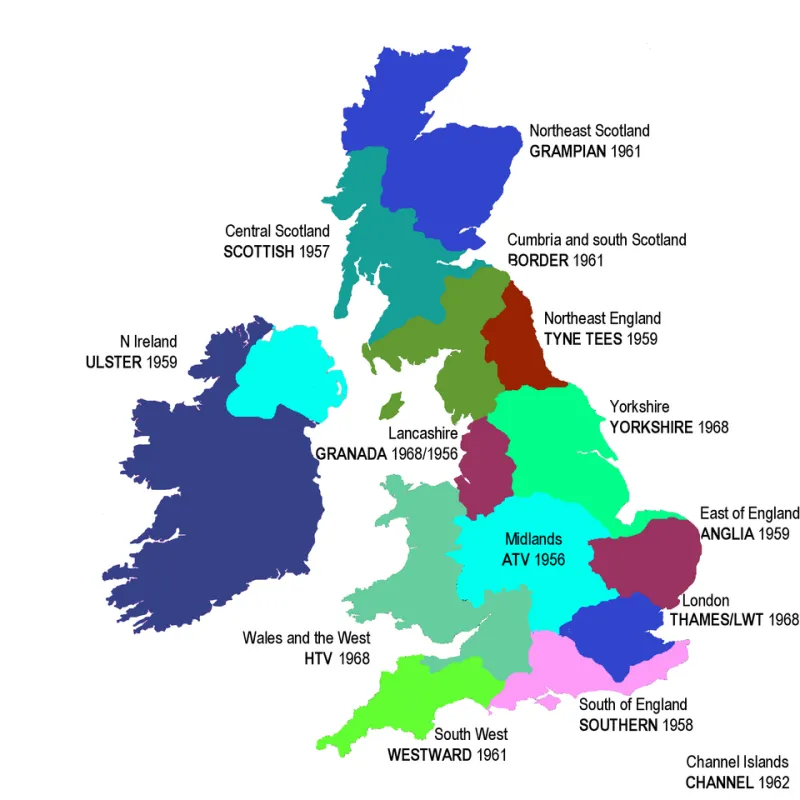
Photo: No machine-readable author provided. Redvers assumed (based on copyright claims)., Public domain, via Wikimedia Commons
British television used to sound like places. A schedule in Carlisle did not feel exactly like a schedule in Cardiff, and neither felt exactly like London. In 2026, that difference is thinner. Regional opt-outs have been reduced, local news has been consolidated, and regional drama is commissioned more often as a one-off than as a habit. The schedules still have a map, but it is drawn at a larger scale and with fewer names on it.
This matters because a schedule is not a neutral container. It is an argument about what a shared public is. When every viewer receives the same London-facing feed, with a short local insert at the edges, television quietly teaches that the centre is the real story and the regions are variations on it. A proper view of the UK cannot be a view from one city.
The Schedule as a Map
Regional opt-outs were never romantic. They were practical: local news, weather, sport, council coverage, consumer reporting, the small emergencies of a place. They were also imperfect, underfunded and sometimes parochial. But they gave viewers a daily proof that their area existed in the national medium. The opt-out was a modest form of pluralism: a few minutes in which the address changed.
The economics have since turned against that pluralism. Linear audiences are falling, advertising is harder to sell, and consolidation promises savings. Regional programming can look like inefficiency on a spreadsheet. Yet the same pressures make regional identity more valuable, not less. In a media environment dominated by national and international feeds, the local bulletin is one of the few places where a viewer sees their own street, school or council meeting.
The Shrinking Opt-Out
What remains in 2026 is a patchwork. BBC regional television still provides local news and current affairs, but its resources are stretched. ITV's regional news persists, though the number of distinct programmes has shrunk over the years. STV and UTV maintain their own identities within the devolved nations, while Channel 4's regional production quotas support work made outside London without necessarily producing regional schedules. Local television stations exist, but few have the reach or stability of the old opt-outs.
The result is a schedule that is national by default and regional by exception. Local news is often the only surviving opt-out; regional drama is rarer; regional current affairs is squeezed. The viewer in Norwich or Swansea may still see a local bulletin, but the surrounding evening is built for a national audience. The map has not disappeared. It has been simplified.
One Feed for All
The flattening has consequences beyond news. Regional drama does not simply supply accents. It supplies production bases, writing talent, crew, locations and stories that do not begin from a London premise. When regional drama is reduced, the effect is not only that fewer programmes are set outside the South East. It is that fewer programmes are made outside the South East, and the pipeline of people who can make them narrows.
There is also the subtler matter of weather, travel and public information. A national feed can report a storm in the abstract while a local audience needs to know which road is closed. This is not a trivial point. Television's public service value is often most visible when it is most local: in emergencies, in council scandals, in the small daily facts that national news cannot carry.
What Regional Broadcasters Still Offer
Regional broadcasters still offer something worth defending. They provide trusted local news, a training ground for journalists and production staff, and a sense of place that streaming algorithms cannot replicate. They sell advertising to local businesses and give public institutions a forum. They are not relics. They are infrastructure.
But they need terms that match the task. Quotas should measure distinctiveness, not just hours. Public service broadcasters should commission regional drama and current affairs as ongoing commitments, not occasional projects. Regulators should ask whether regional variants are genuinely visible on connected televisions and streaming interfaces, not buried behind a national default. And audiences should be able to find their region without knowing the code.
A Map Worth Drawing
The case for regional television is not a case for nostalgia. It is a case for a more accurate picture of the country. A national schedule that speaks only from London is not neutral; it is partial. A proper view requires the schedule to hold more than one place at once.
If the schedule is a map, it should show more than the capital. It should show the towns that still wait for their bulletin, the regions that still make drama, and the viewers who still expect to see themselves reflected without having to travel to the centre. In 2026, that map is thinner than it should be. The work of redrawing it is not sentimental. It is the basic business of public television.