The Intelligibility Problem: Why British Drama Has Grown Quiet
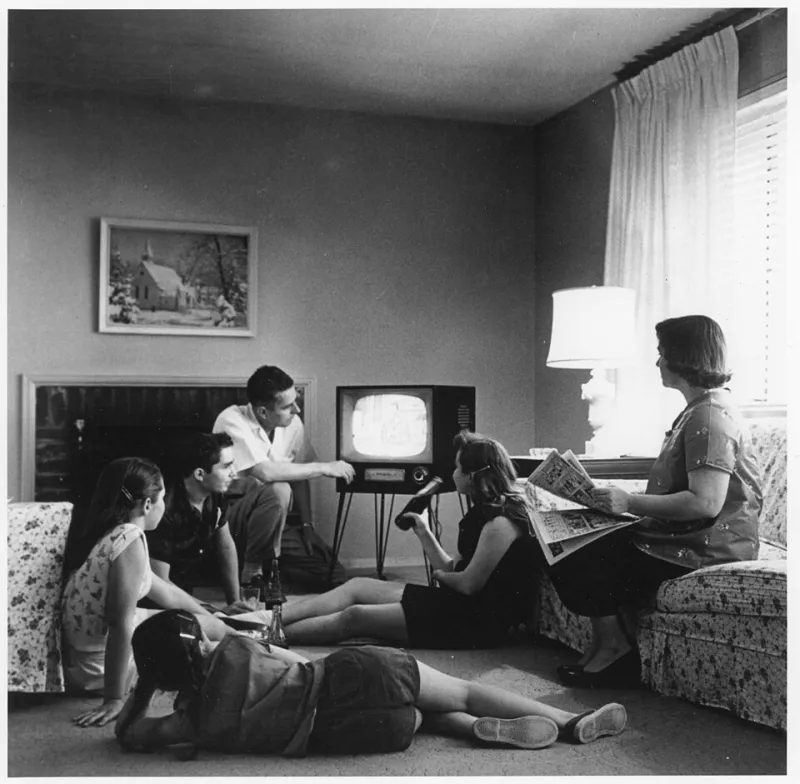
Photo: Evert F. Baumgardner, Public domain, via Wikimedia Commons
The complaint arrives with almost every major British drama now, and it arrives in the same words: I cannot hear what they are saying. It surfaces on points-of-view programmes, in the correspondence columns, in the running commentary that accompanies any Sunday-night thriller on social media. The response from the industry has, for the best part of a decade, been polite and largely immovable. The subtitles are there. Use them.
The subtitle button is now one of the most-pressed keys on the British remote control, and that is not, in itself, a scandal. What is worth examining is how a technical and aesthetic problem became a matter of personal responsibility — and why a country with one of the most sophisticated broadcasting cultures in the world has been so reluctant to fix it.
The complaint that will not go away
The modern template was set in 2014, when BBC One's adaptation of Jamaica Inn prompted a volume of complaints unusual even by the standards of period drama. The corporation's position then, and largely since, has been that the mix is signed off by the director as an expression of creative intent, and that the flat panels in most living rooms are poorly equipped to reproduce it. Both of those statements can be true at once. That is what makes the argument so durable.
What has changed since is not the complaint but the viewer's response to it. Where audiences once telephoned the broadcaster, they now simply turn on subtitles, adjust the volume during music and accept that a portion of the dialogue will be lost. The complaint has not been answered. It has been absorbed.
It is not simply diction
There is a lazy version of this argument that blames actors. It holds that a generation of performers, raised on naturalism and encouraged to whisper, has abandoned the projection skills of a previous era. There is a grain of truth in it: the modern close-up permits a quietness that a wider frame did not, and a whisper carries an intimacy that a stage-trained delivery cannot.
But the accusation of mumbling is often something else in disguise. It attaches with suspicious frequency to regional accents, to dialects the metropolitan ear finds unfamiliar, to performances that are doing something deliberate with class and place. A drama set in a council flat or a Borders farm is not necessarily badly recorded because a London reviewer needed the subtitles. Broadcasters ought to be careful about using the language of clarity to smooth away exactly the texture that makes British drama distinctive.
The genuine problem is upstream of the performance. It sits in the mix.
Mixed for the dub stage, delivered to the kitchen
Modern British drama is finished to a cinematic specification. Dialogue, music and effects are balanced for a calibrated room, with a wide dynamic range and a taste for the dramatic swell. Delivery requirements for broadcast have traditionally sat around −23 LUFS under the EBU R128 standard, while the major streaming platforms specify a dialogue-gated loudness closer to −27 LKFS. Those figures are not household knowledge, but their consequence is: when a mix built around a large dynamic swing is normalised down for streaming, the quiet ends get quieter and the loud ends stay loud.
Then the delivery chain does its own damage. A 5.1 mix folded down to stereo can leave the centre channel — where the dialogue lives — under-represented. A television a few centimetres thick cannot produce low-frequency energy without distorting, and its downward-firing speakers have no surface to work against. A viewer without a soundbar is, in effect, listening to a mix through a compromise the mixer never heard.
Add the domestic context: a fan, a dishwasher, an open-plan kitchen, a child asleep upstairs. The drama was not mixed for that room. Nobody in the dubbing theatre has ever been in it.
The broadcaster's bind
None of this is secret, and the reasons for inaction are not mysterious. Remixing costs money, and the director's sign-off is treated as final. Audio description, translation and access services already compete for the limited resources attached to secondary audio. And there is a legitimate fear of the volume war: a broadcaster that boosts dialogue for one drama invites the accusation that it is treating its audience as incapable.
The likeliest remedy is not a single remix but an option. One major streaming service already offers a dialogue-boost setting on selected titles, its labelling refreshingly plain. There is no technical reason why a comparable toggle — clearly named, consistently placed, available on every programme rather than a chosen few — could not become standard on the domestic catch-up players. A setting that says, in effect, this is the same drama with the speech brought forward, is not an insult to the director. It is what the volume control already does, only better.
The subtitle is a proper view, not a defeat
It should be said plainly that watching with subtitles is not a failure of attention or of hearing. Many viewers came to the habit through foreign-language television and never left; many more rely on them for reasons of access. Subtitles are a legitimate way to watch, and the snobbery that surrounds them belongs to an earlier era of television criticism.
But there is an important distinction between choosing subtitles and needing them because the alternative is guesswork. The first is a preference. The second is a defect in the product, quietly transferred to the customer.
The regulatory ground is shifting in any case. The Media Act of 2024 brought on-demand services within reach of accessibility rules that terrestrial broadcasters have observed for years, and it would be a peculiar outcome if the streaming era ended up with better subtitling but worse sound.
What a proper fix would look like
The industry knows how to do this. Mixes could be monitored on domestic equipment rather than only in the theatre. A dialogue-forward variant could be prepared alongside the primary mix, at a marginal cost, and labelled without embarrassment. Subtitles could be accurate, well-timed and properly styled across every player, rather than an afterthought bolted onto the interface.
What is required, above all, is an admission that intelligibility is part of craft rather than a concession to it. A line of dialogue that cannot be heard has not been performed, recorded and mixed. It has been lost. British television is too good at everything else to keep losing it.