Tuning In Together: The Quiet Case for Scheduled Television
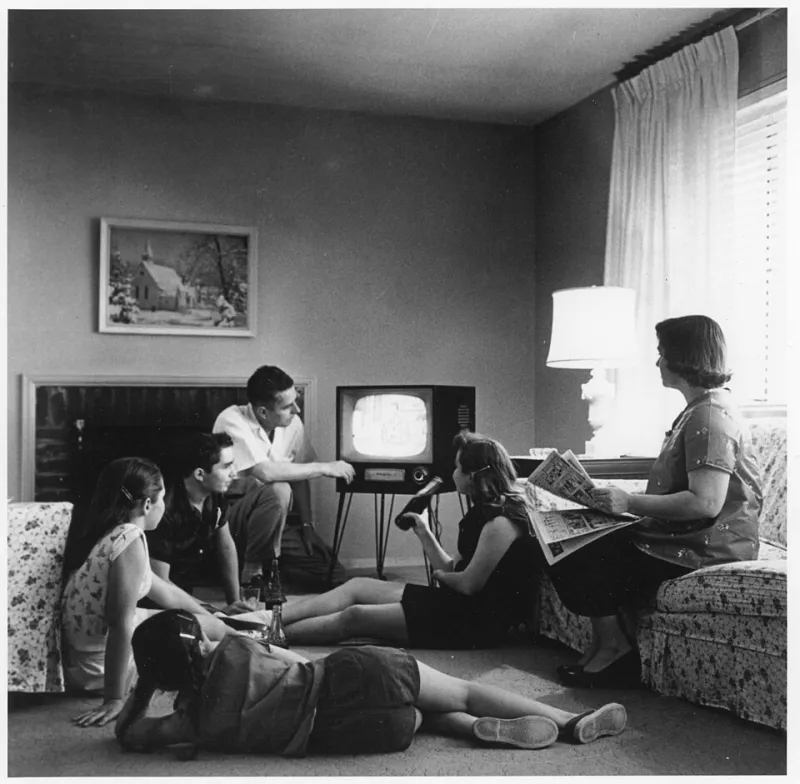
Photo: Evert F. Baumgardner, Public domain, via Wikimedia Commons
The box-set drop has become the default setting for serious television. A new drama arrives with eight episodes, a press campaign and a collective instruction to consume it before the conversation moves on. There is nothing inherently wrong with choice. But the rush to release everything at once has eroded something valuable: the shared rhythm of weekly television, the anticipation that builds between episodes and the space to think about what you have watched.
The architecture of anticipation
Weekly scheduling is often dismissed as a legacy of linear broadcasting, a hangover from the days when viewers had no alternative. That is too simple. The weekly slot was never just a distribution mechanism. It was an editorial form. A series written for seven or ten weeks could develop its characters slowly, allow a subplot to breathe and trust the audience to return. The gap between episodes was not dead time. It was part of the experience.
British broadcasting understood this well. The serialised drama, the soap opera and the Sunday-night staple all depended on routine. Families arranged their evenings around programmes; workplaces filled with speculation the next morning. That social function was not incidental. It gave television a civic dimension, a set of shared references that did not require a subscription to a particular platform. The water-cooler conversation was a cliché, but it described something real: a culture in which viewers had time to disagree.
What all-at-once does to the conversation
The all-at-once release compresses that conversation into a weekend. Reviewers race to publish, audiences race to finish, and anyone who falls behind risks encountering spoilers before they have had a chance to form a view. The result is not a richer discussion but a faster one. Television is consumed as a task, then filed away. The algorithm measures completion; it does not measure reflection.
For British programme-makers, the pressure is acute. A drama that needs time to establish its world may be judged on its opening episode alone. A comedy that builds slowly may be abandoned before it finds its rhythm. The weekly slot gave shows room to grow; the box-set drop demands immediate payoff. That is not a neutral change in distribution. It shapes what gets commissioned and how it is written.
The streamers are learning
There are signs that the industry recognises the problem. Several platforms have experimented with weekly releases for flagship titles, sometimes splitting a season into two parts. These are not acts of nostalgia. They are commercial decisions, driven by the realisation that a weekly rollout can sustain attention for longer, generate more press coverage and reduce churn. The old model had its inefficiencies, but it also had a logic that streaming is now rediscovering.
The lesson is not that every programme should be released weekly. Different shows suit different patterns. A tightly plotted thriller may benefit from a binge; a character-led drama may benefit from a pause. The mistake is to treat all-at-once as the only modern option. A mixed ecology is possible, and it is already emerging.
Reclaiming the slot without nostalgia
To defend weekly television is not to pretend that the past was better. Linear schedules were often paternalistic, and viewers with unusual tastes were poorly served. The point is not to restore a vanished era but to recover a principle: that television benefits from structure, and that audiences benefit from time. A weekly slot can coexist with on-demand access. It can be a deliberate editorial choice rather than a default.
For public service broadcasters, there is a particular opportunity. The BBC and Channel 4 still have the reach and the cultural authority to make a weekly schedule matter. They can use it to build audiences for difficult work, to give programmes a life beyond the opening weekend and to foster the kind of conversation that does not depend on having binged everything by Monday. That is not a plea for the past. It is a case for a proper view of television as something more than content.
The weekly wait was never merely an inconvenience. It was a form of respect for the audience, and for the work. In a market obsessed with speed, that is worth reclaiming.